
Something slightly awkward is happening in Europe right now.
While consumers are busy buying collagen gummies, creatine sachets and magnesium blends to survive modern life, regulators across the EU are quietly discussing proposals that could significantly reduce the permitted strength of many vitamins, minerals and botanical ingredients used in food supplements.
And if some of these proposals eventually move forward? A large portion of the supplement industry may be heading for reformulation season.
Potentially affected ingredients include Magnesium, Vitamin C, Vitamin D3, Vitamin B6, Zinc, Ashwagandha, Curcumin, Piperine, St John’s Wort, Maca and dozens more — many of which sit at the heart of formulations targeting immunity, cognition, longevity, beauty, sports nutrition and women’s health.
In other words: pretty much the entire supplement aisle.
At Virun®, we’ve been closely monitoring developments surrounding EU harmonisation discussions, EFSA upper intake evaluations and the increasing scrutiny of botanical ingredients under Article 8 procedures. And while nothing has been fully finalised yet, the direction of travel is becoming difficult to ignore.
Why This Matters For Supplement Brands
For years, Europe has operated in a slightly awkward middle ground when it comes to supplement regulation.
Directive 2002/46/EC established which vitamins and minerals may legally be used in supplements across the EU, while leaving room for member states to apply their own interpretations and guidance around dosage levels.
The result? A fragmented market where what is perfectly acceptable in one country may trigger regulatory headaches in another.
Now, discussions around harmonised maximum permitted levels are gaining momentum again — particularly for higher-dose vitamins and minerals. At the same time, botanicals and adaptogens are increasingly being scrutinised under Article 8 procedures, which allow the EU to restrict or prohibit substances where safety concerns are raised.
For brands, this creates a rather uncomfortable reality:
Today’s “high-strength hero product” could become tomorrow’s reformulation project.
The Ingredients Under The Microscope
Below is a simplified overview of ingredients currently attracting industry attention. The “Current Common Market Levels” reflect dosages frequently found in existing European supplement products, while the “Potential Future Restrictive Levels” reflect figures and discussions circulating within regulatory and industry conversations. These are not yet finalised law.
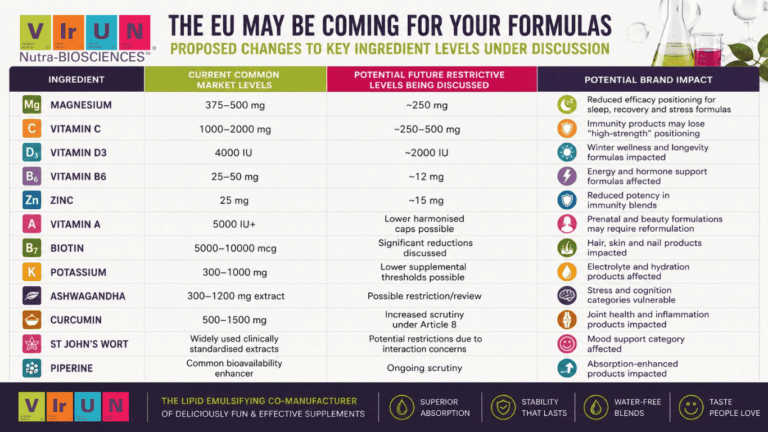
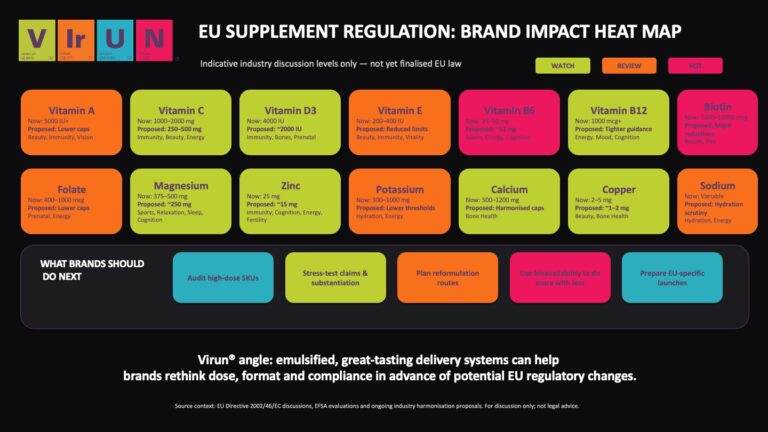
And this is before we even get into berberine, hydroxycitric acid, fennel preparations and the growing list of substances under additional review.
Reformulation Is About To Become A Strategic Skill
For manufacturers and brands, this isn’t simply a legal conversation.
It’s a formulation conversation.
A flavour conversation.
A dosage delivery conversation.
And, increasingly, a consumer compliance conversation too.
If active levels are reduced, brands may need to rethink how products are delivered and absorbed in the first place.
Because if consumers can no longer rely on brute-force dosing, bioavailability suddenly matters a lot more.
This is one of the reasons lipid emulsions, micellar delivery systems and functional food formats are attracting so much attention right now. If regulations eventually push brands toward lower active levels, technologies that improve absorption, stability and compliance may become significantly more important commercially.
Frankly, swallowing eight capsules a day to achieve a meaningful dose was never particularly glamorous anyway.
The Manufacturing Challenge Nobody Is Talking About
For brands that sell into Europe and for European manufacturers — including facilities like ours in Newbridge, Ireland — regulatory shifts create enormous operational implications.
Brands may need to:
- reformulate existing SKUs
- relabel products
- reassess claims
- revisit stability testing
- source alternative ingredients
- validate lower-dose efficacy
- adjust flavour systems
- update market-specific formulations
And for brands operating across multiple territories? Things become even more entertaining.
A formulation acceptable in the US may no longer align with future EU expectations. Meanwhile, differing interpretations between member states continue to create uncertainty around botanicals, novel foods and functional ingredients.
Safety Matters. But So Does Consumer Choice.
To be clear: nobody sensible is arguing against evidence-based safety standards.
Responsible manufacturing, transparent labelling and scientifically grounded regulation are essential for consumer trust and long-term industry credibility.
But many brands, retailers and consumers are asking an equally important question:
At what point does “consumer protection” begin reducing meaningful access to wellness products consumers actively choose and use responsibly?
Nutrition is not one-size-fits-all.
Neither are lifestyles.
Nor health goals.
Nor sunlight exposure.
Nor training demands.
Nor ageing.
And many across the industry believe consumers should continue to have access to meaningful, functional levels of nutrients without everything drifting toward the nutritional equivalent of homeopathy.
What Brands Should Be Doing Now
Whether or not the final proposals arrive exactly as currently discussed, smart supplement brands should already be preparing for change.
That means:
- auditing ingredient exposure
- reviewing high-dose formulations
- monitoring Article 8 developments
- assessing alternative delivery systems
- strengthening substantiation dossiers
- considering bioavailability-enhancing technologies
- building more flexible formulation strategies for EU markets
Because if Europe does move toward stricter harmonised limits, the brands that adapt early will be in a far stronger position than those scrambling later.
Join The Conversation
This is an important moment for the future of nutritional innovation in Europe.
If you believe consumers should continue to have access to meaningful supplement formulations and informed choice, you can support the ongoing industry conversation here:
Support the petition: https://lnkd.in/eBRV59CY
At Virun®, we’ll continue monitoring developments closely while helping brands navigate formulation, stability and delivery challenges as the regulatory landscape evolves.
Preferably with fewer boring capsules involved.
Meet us this year:
IFT – Chicago | July 12–15 | Booth 449
SupplySide Global – Las Vegas | October 28–30 | Booth 3437
If you’re ready to rethink delivery, let’s talk. Email us innovate.today@virun.com