
Creatine is having a moment.
It’s moved beyond bodybuilding and into healthy aging, cognition, women’s perimenopausal and menopausal support, muscle preservation and everyday performance. Glutathione, meanwhile, has become one of the most popular ingredients for cellular protection, healthy aging and antioxidant support.
Naturally, brands want both ingredients in more convenient formats.
Shots. Gels. Pouches. Liposomal liquids.
But there’s one rather inconvenient formulation problem.
Neither creatine nor glutathione particularly enjoys sitting around in water.
And putting “liposomal” on the front of a bottle doesn’t magically change the chemistry inside it.
Creatine + water: it’s complicated
Creatine monohydrate is exceptionally stable as a dry crystalline powder.
Put it into an aqueous solution and the story changes.
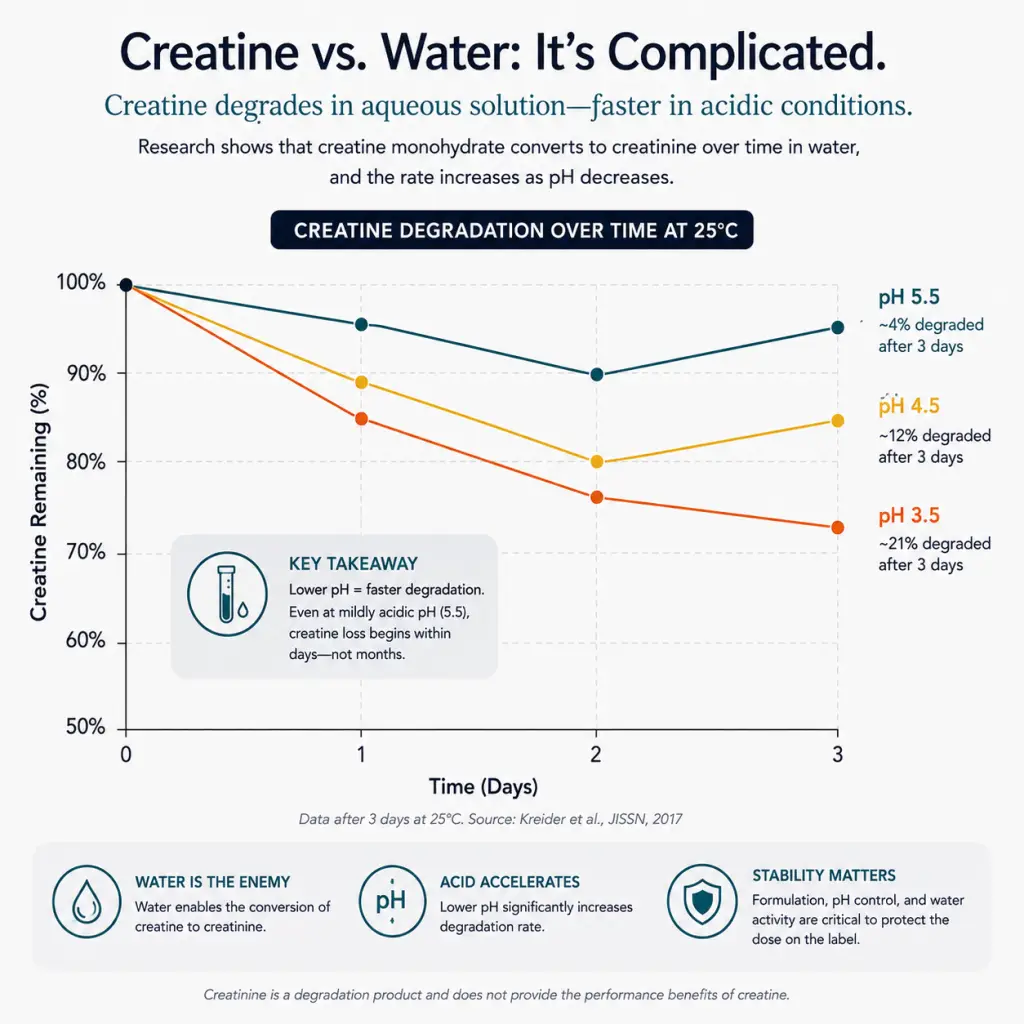
Over time, creatine can cyclize into creatinine—a degradation product that does not provide the ergogenic benefits associated with creatine. The reaction accelerates as temperature increases and pH decreases.
And the difference isn’t trivial.
Published research cited by the International Society of Sports Nutrition found that after just three days at 25°C, approximately:
4% degraded at pH 5.5
12% degraded at pH 4.5
21% degraded at pH 3.5
Which is why we’re always interested when we see gram-level doses of creatine appearing in conventional water-based supplements.
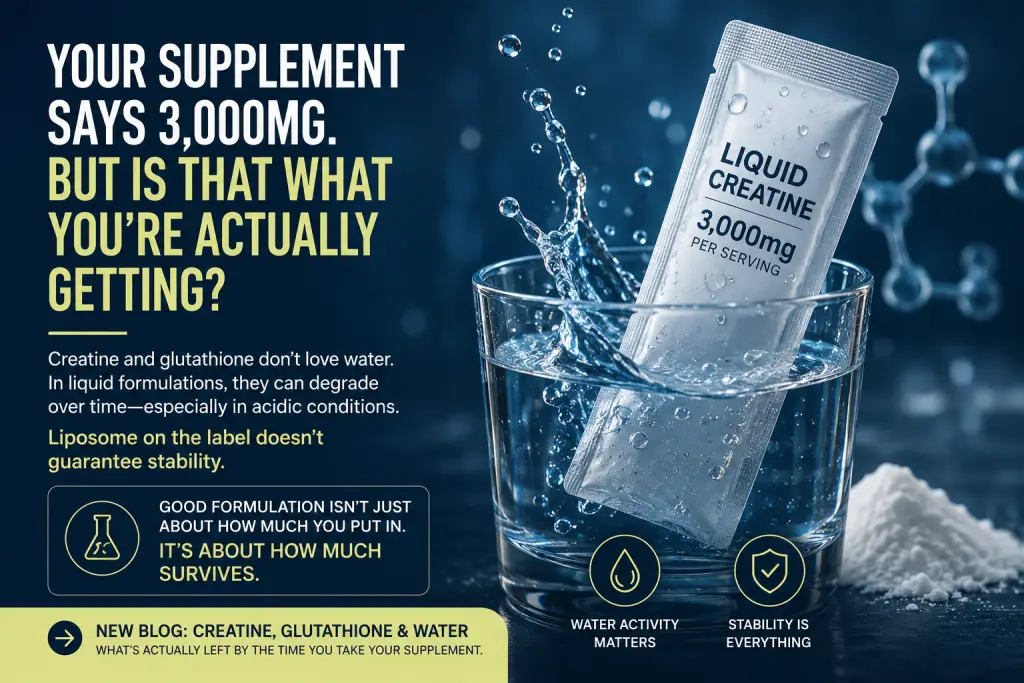
One liquid creatine product currently available through a leading retailer, for example, declares 3,000mg creatine monohydrate per serving, while its disclosed formulation lists purified water as the first “other ingredient” and also contains citric acid.
Does that automatically mean the finished product is unstable?
No.
But from a formulation perspective, it certainly raises questions.
Water creates the environment in which degradation can occur. Acidic conditions can accelerate it.
So, if a water-based creatine product claims long-term stability, we want to see the science: creatine assays at multiple timepoints, separate creatinine measurements, pH, water activity, storage conditions, temperature, packaging configuration and the validated analytical method.
Because a stability claim on a marketing graphic isn’t quite the same thing as stability data.
And then there’s glutathione…
Creatine isn’t the only popular ingredient with a water problem.
Glutathione can be rather demanding too.
Glutathione (GSH) is a tripeptide composed of glutamate, cysteine and glycine. Produced naturally within the body, it is an important intracellular antioxidant that helps protect cells against oxidative stress.
It shields cells against endogenous and exogenous oxidative species—essentially helping our bodies deal with the oxidative consequences of normal metabolism and environmental exposure.
An incredibly useful little compound.
An incredibly awkward one to formulate.
For antioxidant activity, glutathione needs to be maintained in its reduced form (GSH). Yet GSH can suffer from poor stability in aqueous environments, including oxidation to its disulfide form and other degradation pathways.
Researchers investigating glutathione-loaded nanoemulsions describe GSH as suffering from “low stability in water”and investigated encapsulation specifically as a strategy to improve its stability in aqueous systems.
So once again, we come back to the same question:
How much active ingredient is actually left when your customer consumes the product?
But it says “liposomal”…
Great.
Show us the delivery system.
Calling a water-based creatine or glutathione product “liposomal” does not automatically demonstrate stability, protection or bioavailability.
Liposomes, micelles, nanoemulsions and other lipid delivery technologies can be incredibly effective tools—but they have to be properly engineered around the chemistry of the active ingredient.
For glutathione, that means considering its oxidation state, oxygen exposure, water activity, lipid environment, processing conditions, packaging and gastrointestinal stability.
For creatine, it means understanding the relationship between water, pH, temperature and time.
Because the delivery system isn’t decoration.
It’s part of the formulation.
At Virun®, we formulate around the ingredient
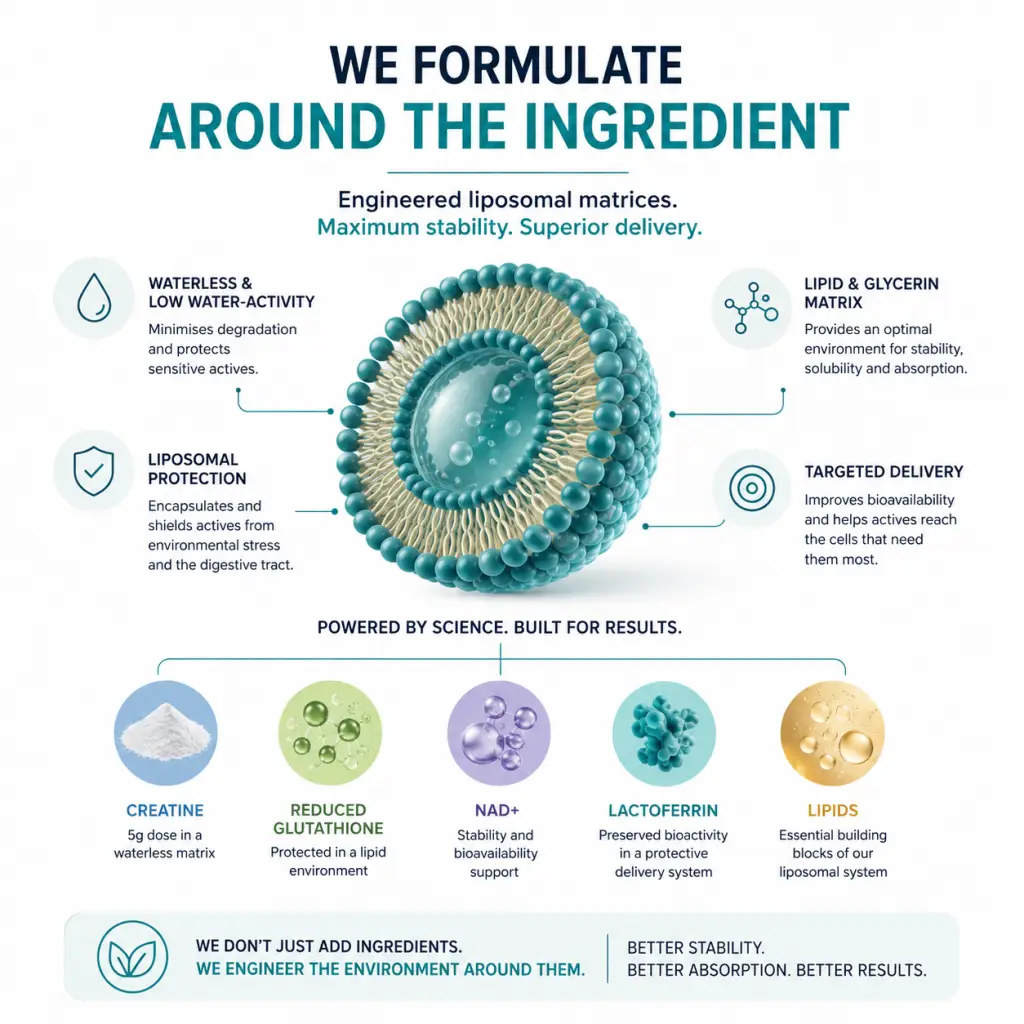
Rather than putting an active into an environment it doesn’t particularly like and hoping for the best, we engineer the environment around the active.
Virun has developed waterless and low-water-activity lipid and glycerin delivery systems designed around the known stability challenges of ingredients including creatine and glutathione.
For creatine, we’ve developed commercial formulations capable of delivering a full 5g dose of creatine monohydrate in waterless lipid and glycerin matrices, including single-serve pouches, gels and Creamy Edible Emulsions®.
For reduced glutathione, lipid-based delivery technologies can be used to protect the active and create a more appropriate environment for a molecule notoriously difficult to formulate and deliver orally.
And when multiple challenging actives are combined?
That’s where formulation becomes particularly interesting.
Creatine. Reduced glutathione. NAD+. Lactoferrin. Lipids.
Each has different chemistry. Different stability considerations. Different delivery challenges.
You can’t simply throw them all into water, call it liposomal and hope everyone behaves themselves.
The dose on the label should be the dose received
This is the bit we think the supplement industry needs to talk about more.
A label might say:
3,000mg creatine.
500mg glutathione.
15mg NAD+.
But how much went into the product on manufacturing day isn’t the only question.
What matters is what remains active and available three months, six months, twelve months or eighteen months later—when somebody actually consumes it.
That’s why stability shouldn’t be something you test as an afterthought.
Water activity, pH, oxygen exposure, processing conditions, packaging and delivery technology need to be considered from the beginning.
At Virun®, that’s precisely what we do.
Because putting an impressive dose on a label is relatively easy.
Making sure it’s still there when your customer opens the pouch?
That’s the clever bit.
Get in touch with us innovate.today@virun.com to create your own stable and efficacious supplements.
References
Kreider RB, et al. International Society of Sports Nutrition position stand: safety and efficacy of creatine supplementation in exercise, sport, and medicine. Journal of the International Society of Sports Nutrition. 2017;14:18.
Uzzan M, et al. A simple spectrophotometric method for the determination of creatine stability in aqueous solutions. Drug Development and Industrial Pharmacy. 2009.
Antonio J, et al. Common questions and misconceptions about creatine supplementation: what does the scientific evidence really show? Journal of the International Society of Sports Nutrition. 2021.
Yeşiltepe O, Güler Çelik E, Geyik C, et al. Preparation of glutathione loaded nanoemulsions and testing of hepatoprotective activity on THLE-2 cells. Turkish Journal of Chemistry. 2021;45(2):436–451.
Want to formulate challenging ingredients properly? Contact us:
innovate.today@virun.com
Powered by VIRUN®